
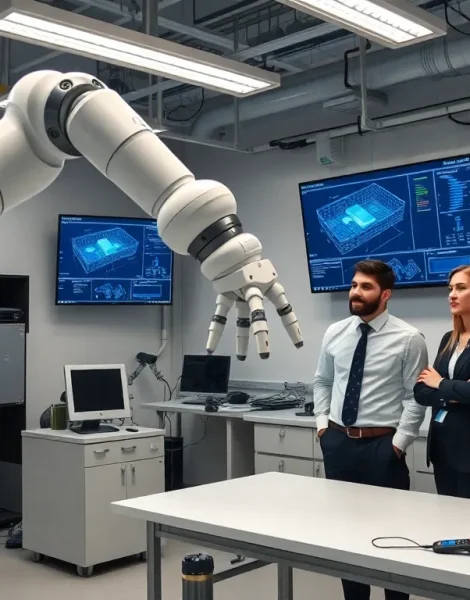
Robotics techniques define how machines perceive, decide, and act in real-world environments. From factory floors to surgical suites, these methods power the automation systems that handle tasks once reserved for humans. Engineers combine programming, sensing, AI, and motion planning to build robots that work faster, safer, and smarter than ever before. This article breaks down the core robotics techniques driving modern automation, and explains why each one matters.
Table of Contents
ToggleKey Takeaways
- Robotics techniques combine programming, sensing, AI, and motion planning to enable machines to perceive, decide, and act in real-world environments.
- Control systems like PID controllers and model predictive control (MPC) allow robots to execute precise movements and adapt to dynamic tasks in real time.
- Vision systems, LIDAR, and SLAM are essential robotics techniques that give robots the ability to see, map environments, and navigate without pre-loaded maps.
- Machine learning and deep learning enable robots to recognize objects, learn through trial and error, and improve performance without explicit programming.
- Path planning algorithms like A* and RRT calculate collision-free routes, while trajectory optimization ensures smooth, energy-efficient movements.
- Collaborative robots (cobots) use human-aware motion planning to safely share workspaces with people without sacrificing productivity.
Core Programming and Control Techniques
Every robot needs instructions. Programming and control techniques tell robots what to do, when to do it, and how to respond to changing conditions.
Traditional Programming Methods
Most industrial robots run on structured programming languages like RAPID, KRL, or Python. These languages let engineers define precise movements, sequences, and logic. A welding robot, for example, follows programmed coordinates to apply consistent welds across thousands of parts.
Offline programming has become standard practice. Engineers write and test code in simulation software before uploading it to physical robots. This approach reduces downtime and catches errors early.
Control Systems
Control systems govern how robots execute commands. PID (Proportional-Integral-Derivative) controllers remain popular because they adjust motor outputs in real time based on sensor feedback. If a robotic arm drifts from its target position, the PID controller corrects the error instantly.
More advanced robotics techniques use model predictive control (MPC). MPC calculates optimal actions by predicting future states several steps ahead. This method works well for robots handling dynamic tasks like catching objects mid-air.
Teach Pendants and Manual Programming
Many factories still use teach pendants, handheld devices that let operators manually guide robots through motions. The robot records these movements and repeats them. It’s simple, effective, and doesn’t require deep programming knowledge. These robotics techniques remain valuable for small-batch production where flexibility beats full automation.
Sensing and Perception Methods
Robots need senses to interact with their surroundings. Sensing and perception techniques provide the data robots use to understand objects, distances, and environments.
Vision Systems
Cameras give robots sight. 2D vision systems identify shapes, colors, and positions. They’re common in quality inspection, where cameras spot defects on assembly lines at speeds humans can’t match.
3D vision takes things further. Stereo cameras, structured light sensors, and time-of-flight cameras create depth maps that help robots pick items from bins or navigate cluttered spaces. These robotics techniques have transformed warehouse automation.
Proximity and Force Sensors
Proximity sensors detect nearby objects without contact. Ultrasonic sensors measure distance using sound waves. Infrared sensors work well for short-range detection. Both prevent collisions and enable safe human-robot collaboration.
Force and torque sensors measure pressure during contact. Assembly robots use them to insert parts with the right amount of force, too little and the part won’t seat: too much and something breaks.
LIDAR and SLAM
LIDAR (Light Detection and Ranging) fires laser pulses to map environments with millimeter accuracy. Autonomous mobile robots depend on LIDAR to navigate warehouses and outdoor spaces.
SLAM (Simultaneous Localization and Mapping) combines sensor data to build maps while tracking the robot’s position within them. These robotics techniques enable robots to operate in unknown environments without pre-loaded maps.
Machine Learning and Artificial Intelligence in Robotics
Machine learning and AI let robots improve through experience rather than explicit programming. These robotics techniques handle tasks that traditional code struggles with.
Deep Learning for Perception
Deep neural networks process camera feeds to recognize objects, people, and gestures. A robot trained on thousands of images can identify a specific part on a conveyor belt even when lighting changes or the part rotates. This adaptability makes deep learning essential for modern robotics techniques.
Reinforcement Learning
Reinforcement learning trains robots through trial and error. The robot attempts actions, receives rewards or penalties, and adjusts its behavior. Over time, it discovers effective strategies without human guidance.
This approach has taught robotic hands to manipulate objects with human-like dexterity. It’s also used for walking robots that learn to balance across uneven terrain.
Generative AI and Large Language Models
Recent advances let robots interpret natural language commands. A warehouse worker can say “bring me the red box from shelf three” and the robot understands. Large language models translate human intent into machine actions, making robotics techniques more accessible to non-experts.
Limitations
AI-powered robots need significant training data and computing power. They can also fail in unexpected ways when facing situations outside their training. Engineers combine AI with traditional safety systems to manage these risks.
Motion Planning and Navigation Strategies
Motion planning answers a fundamental question: how does a robot get from point A to point B without hitting anything?
Path Planning Algorithms
Algorithms like A* and RRT (Rapidly-exploring Random Trees) calculate collision-free paths through space. A* works well for grid-based maps, finding the shortest route efficiently. RRT handles high-dimensional spaces where robotic arms have many joints to coordinate.
These robotics techniques run constantly as robots operate. When obstacles appear, the system recalculates paths in milliseconds.
Trajectory Optimization
Path planning finds where to go. Trajectory optimization determines how to move along that path. It factors in speed, acceleration, jerk, and joint limits to create smooth motions that don’t stress mechanical components.
Optimal trajectories also save energy. Industrial robots running optimized paths consume less power and generate less heat, both matter at scale.
Navigation for Mobile Robots
Mobile robots face additional challenges. They must avoid moving obstacles, follow traffic rules in shared spaces, and handle sensor noise. Modern robotics techniques layer multiple systems: global planners chart overall routes while local planners handle immediate obstacles.
Autonomous vehicles use similar approaches but add lane detection, traffic sign recognition, and prediction of other drivers’ behavior.
Human-Aware Motion
Collaborative robots, cobots, share workspaces with people. Their motion planning includes safety constraints that slow or stop movements when humans get close. Speed and separation monitoring ensures safe coexistence without sacrificing productivity.


