
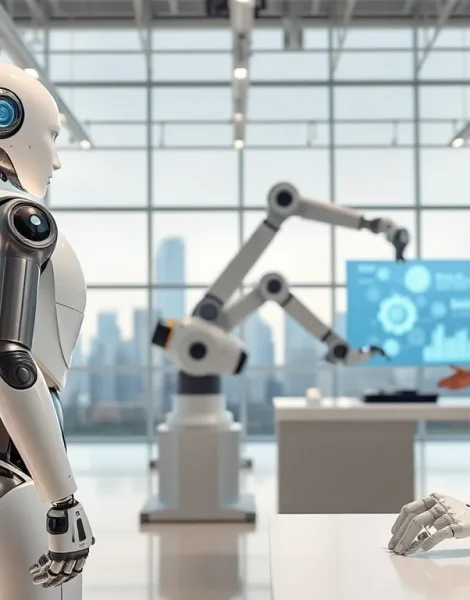
Robotics trends 2026 will reshape industries, homes, and workplaces in ways few predicted even five years ago. The pace of innovation has accelerated dramatically. Robots now perform surgery, deliver packages, and assemble electric vehicles with precision that matches or exceeds human capability. In 2026, several key developments will define the industry’s direction. AI integration will reach new levels of sophistication. Humanoid robots will move from research labs to commercial applications. Collaborative robots will become standard fixtures in factories and warehouses. Soft robotics will blur the line between machine and living organism. This article examines the most significant robotics trends 2026 has in store, and explains why they matter for businesses and consumers alike.
Table of Contents
ToggleKey Takeaways
- Robotics trends 2026 will be defined by AI-powered autonomy, enabling robots to learn from their environment and adapt in real time without pre-programmed instructions.
- Humanoid robots like Tesla’s Optimus are transitioning from prototypes to mass production, designed to work in human-built environments without costly modifications.
- Collaborative robots (cobots) are projected to exceed a $2 billion market by 2026, offering small businesses affordable automation with easy teach-by-demonstration programming.
- Soft robotics using flexible materials will expand into medical, agricultural, and ocean exploration applications where traditional rigid robots cannot operate safely.
- Edge computing and foundation models for robotics will reduce latency and give robots general-purpose intelligence that can be customized for specific tasks.
- Manufacturing cost reductions of roughly 40% since 2023 are making advanced robotics accessible to more industries and accelerating widespread adoption.
AI-Powered Autonomy and Machine Learning Integration
The biggest robotics trends 2026 will bring involve artificial intelligence. Specifically, robots will gain unprecedented decision-making abilities through advanced machine learning models.
Today’s industrial robots follow pre-programmed instructions. They repeat the same motions thousands of times without deviation. The next generation operates differently. These machines observe their environment, learn from mistakes, and adapt their behavior in real time.
Large language models (LLMs) now enable robots to understand natural language commands. A warehouse worker can simply tell a robot, “Move those boxes to aisle seven,” and the machine executes the task. No coding required. No specialized training necessary.
Computer vision has improved dramatically as well. Robots can now identify objects they’ve never seen before by comparing them to learned patterns. This capability proves especially valuable in agriculture, where robots must distinguish ripe produce from unripe items across countless varieties.
Reinforcement learning allows robots to master complex tasks through trial and error. Boston Dynamics’ Spot robot, for example, learns to traverse new terrain by testing different gaits and remembering what works. Each failure teaches the system something valuable.
The robotics trends 2026 will accelerate also include edge computing. Rather than sending data to cloud servers for processing, robots will handle AI computations locally. This reduces latency and improves response times, critical factors in safety-sensitive applications like autonomous vehicles and surgical robots.
Expect to see more “foundation models” for robotics emerge this year. These pre-trained AI systems give robots general-purpose intelligence that developers can fine-tune for specific applications. Google’s RT-2 and similar projects have already demonstrated the concept’s viability.
Humanoid Robots Enter the Mainstream
Humanoid robots have existed for decades, mostly as research curiosities or trade show attractions. That changes in 2026.
Tesla’s Optimus robot has moved beyond prototype status. The company plans mass production, with units potentially available for commercial purchase. Other manufacturers have taken notice. Figure AI, Agility Robotics, and several Chinese firms are racing to bring their own humanoid platforms to market.
Why humanoids? The answer is simple: human environments were designed for human bodies. Factories, warehouses, and homes feature stairs, doors, and workstations built for bipedal creatures with two arms. A humanoid robot can operate in these spaces without expensive modifications.
The robotics trends 2026 will bring include humanoids taking on dangerous jobs. Mining companies are testing bipedal robots for underground operations. Nuclear facilities want them for inspection and maintenance tasks. Disaster response teams see potential for search and rescue missions.
Retail applications are emerging too. A humanoid robot can stock shelves, assist customers, and perform inventory counts, all tasks currently requiring human workers who are increasingly difficult to hire.
The economics are shifting favorably. Manufacturing costs for humanoid robots have dropped roughly 40% since 2023. Battery technology improvements mean these machines can now operate for eight-hour shifts without recharging. Sensors and actuators that once cost thousands of dollars now sell for hundreds.
Challenges remain, of course. Humanoid robots still struggle with fine motor tasks like tying knots or handling fragile objects. Their walking gait can appear awkward, and balance on uneven surfaces needs work. But progress has been remarkable, and 2026 will mark the year humanoids transition from novelty to necessity for many businesses.
Collaborative Robots Transforming Workplaces
Collaborative robots, or “cobots”, work alongside humans rather than replacing them. This category represents one of the fastest-growing robotics trends 2026 will see.
Traditional industrial robots operate behind safety cages. They’re powerful, fast, and dangerous to anyone who gets too close. Cobots take a different approach. They use force-limiting technology, advanced sensors, and slower operating speeds to work safely in shared spaces with human workers.
The cobot market reached $1.2 billion in 2024 and analysts project it will exceed $2 billion by 2026. Small and medium-sized businesses drive much of this growth. These companies couldn’t afford or justify traditional automation. Cobots offer a lower-cost entry point with faster return on investment.
Manufacturing applications dominate current cobot deployments. Assembly line workers use cobots to handle repetitive tasks like screw-driving, welding, or quality inspection. The human focuses on tasks requiring judgment and creativity. The robot handles the boring, physically demanding work.
Healthcare represents another growth area for robotics trends 2026. Cobots assist surgeons during procedures, holding instruments steady or positioning cameras. Rehabilitation centers use them to guide patients through physical therapy exercises. Pharmacies deploy them for prescription filling.
The programming barrier has fallen significantly. Modern cobots feature “teach by demonstration” interfaces. An operator physically guides the robot arm through desired motions, and the machine remembers the sequence. No robotics degree required.
Universal Robots, FANUC, and ABB lead the cobot market. But new entrants from China and South Korea are introducing competitive alternatives at lower price points. This competition benefits buyers and accelerates adoption across industries.
Expect to see cobots appear in unexpected places this year, coffee shops, hotel kitchens, dental offices, and construction sites. Anywhere repetitive physical tasks exist, cobots offer a solution.
Advances in Soft Robotics and Biomimicry
Not all robotics trends 2026 involve metal frames and electric motors. Soft robotics represents a fundamentally different approach, machines made from flexible, compliant materials that mimic biological organisms.
Traditional robots excel at precise, repetitive movements in controlled environments. They struggle with soft, irregular objects and unpredictable situations. A standard robotic gripper can lift a metal part with ease but might crush a tomato or drop a wet fish.
Soft robots solve this problem through design. Made from silicone, rubber, or other pliable materials, they naturally conform to objects they grasp. A soft gripper wraps around a strawberry gently, applying just enough pressure to pick it up without damage.
Biomimicry guides much of this research. Engineers study octopus tentacles, elephant trunks, and caterpillar locomotion for inspiration. The results include robots that can squeeze through tight spaces, grip irregularly shaped objects, and move in ways impossible for rigid machines.
Medical applications show particular promise among robotics trends 2026. Soft robotic surgical tools can access hard-to-reach areas inside the body with minimal tissue damage. Wearable soft robots help stroke patients regain mobility by gently assisting their movements. Implantable soft devices could eventually help failing hearts pump blood.
Ocean exploration benefits from soft robotics as well. Rigid underwater robots disturb marine life and struggle in cramped coral reef environments. Soft robots move like sea creatures, blending in and accessing spaces their metal counterparts cannot reach.
Manufacturing challenges have slowed soft robotics adoption. These machines are harder to produce than traditional robots, and they wear out faster. But, 3D printing advances are making soft robot production more economical. New materials offer improved durability without sacrificing flexibility.
By late 2026, soft robots will handle produce in grocery distribution centers, assist with elderly care, and explore environments too delicate for conventional machines.


